A Seasonal Gathering Without a Packed Schedule
A seasonal gathering without a packed schedule can welcome neighbors, share a few meaningful moments, and leave room for different ways to join.
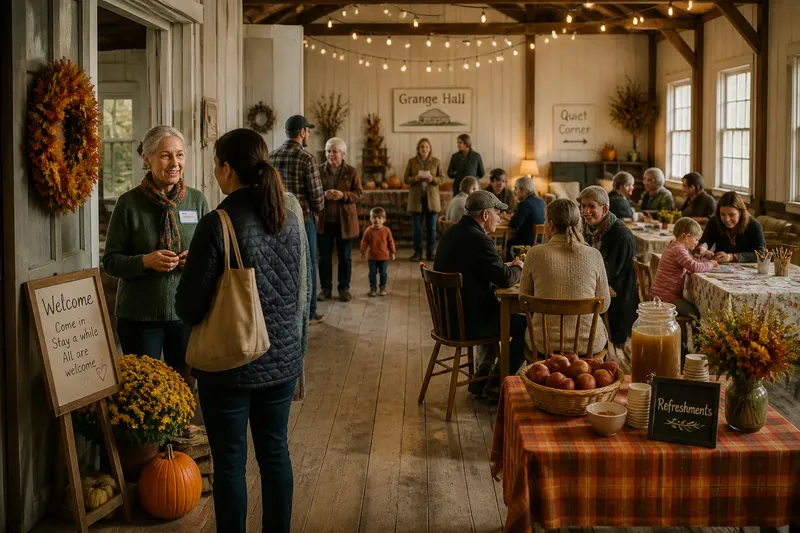
A seasonal gathering without a packed schedule can make it easier for neighbors to arrive, join in, and leave at their own pace. Imagine a small rural community planning an autumn afternoon in a grange hall: the organizers want to mark the harvest, but they do not want the day to feel like a series of appointments. Their useful starting point is not a longer program. It is a clear welcome, a few shared moments, and enough open time for people to make the gathering their own.
The gathering’s purpose
For this invented situation, the planning group includes a library volunteer, a grower, and two neighbors who have helped with local events. They agree on a modest purpose: make it easy for people in the area to spend time together and acknowledge the season. That statement gives them a way to judge suggestions. A proposal belongs if it supports welcome or shared time; it can be set aside if it turns the afternoon into a performance people must catch at a particular moment.
This distinction matters in a place where people may be coming from a shift, a farm chore, a family visit, or a drive from a distant road. A tight timetable can unintentionally reward those who arrive early and stay throughout. A looser shape offers more than convenience: it treats partial participation as legitimate. Someone who has time for a cup of cider and a conversation has still taken part.
The group chooses a familiar indoor venue, the grange hall, because it offers shelter and a recognizable meeting place. They do not assume everyone knows where the entrance is or how the afternoon will work. The invitation names the hall, gives a plain description of the welcome, and says that guests may come and go during the gathering. That small promise begins the event before anyone arrives.
A welcome that holds
Rather than making a speech the opening act, the planners put a greeter near the entrance. The greeter can point out the coat area, refreshments, seating, and the main room, then explain that there is no need to sign up for an activity. A clear welcome is especially helpful for a newcomer who arrives alone, a parent managing children, or someone unsure whether the event is meant for them.
They also make the room legible at a glance. A simple hand-lettered sign identifies the refreshments; another marks a quiet corner with chairs away from the busiest table. A broad path between the entrance and seating keeps the room easier to use for people carrying bags, using mobility aids, or moving with small children. The group avoids covering every wall with instructions. A few well-placed cues are easier to notice than a cluster of competing notices.
The welcome is a role, not a script. The greeter can introduce people who seem open to meeting, but does not press anyone into conversation. A person may prefer to look around first. The gathering’s tone depends partly on honoring that choice, rather than treating sociability as an activity everyone must perform.
Three shared moments
The organizers settle on three moments that can give the afternoon a gentle shape without claiming every minute. First, someone opens the gathering with a brief greeting and names the reason for meeting. Later, a local grower offers a short seasonal observation, such as what has been coming into the market or what people are preserving at home. Near the end, volunteers invite everyone who wishes to help put chairs and serving items back in place.
These moments are deliberately simple. There is no long introduction of every guest, no contest that divides the room into participants and spectators, and no sequence of announcements. The grower is invited to speak conversationally, not to deliver a formal talk. If people gather around, the moment happens; if some remain at the refreshment table, they have not missed the entire event.
Say the group initially proposes a craft demonstration that would require everyone to be seated at a set time. In this hypothetical case, they keep the idea but change its form: a volunteer sets out apples, paper, colored pencils, and a few examples on one table, then works there throughout the afternoon. A child can draw for a while, an adult can ask a question, and a guest with little time can simply pass through. The expected observable result is a table that people approach in small waves, rather than a room that must stop for a scheduled performance.
Open time with purpose
Unscheduled time does not have to mean an empty room. The group gives the afternoon a few places to gather: a refreshment table, the craft table, and chairs arranged for conversation. Each offers a different way to participate. People can contribute a dish if they choose, share a local story, help with the activity, or simply sit and listen.
The organizers avoid assigning every guest a task. That is an important difference between offering opportunities and creating obligations. A community gathering should not make a visitor feel that they must volunteer, bring food, or explain why they have come. The invitation can say that contributions are welcome but not required, so the event remains accessible to people with limited time, money, or energy.
One plain analogy helps the planners test the schedule: it should work like a kitchen table, not a train timetable. A kitchen table can hold several kinds of company at once; a train timetable asks everyone to meet one fixed departure. The analogy does not mean the event needs no organization. It means the organization should support different rhythms instead of treating them as disruptions.
Practical choices
The group makes a few concrete decisions before the day:
- Use one clear invitation. Name the occasion, venue, general time window, and whether guests may arrive late or leave early.
- Choose a greeter. Ask a volunteer to welcome people and explain the room, without requiring them to manage every activity.
- Keep the program short. Write down only the opening, the seasonal moment, and the shared tidying invitation.
- Offer more than one way to join. Set out something to look at or make, alongside places to sit and talk.
- Make refreshments understandable. Label dishes when ingredients are known, and offer a simple non-food way to participate.
- Plan for a quiet pause. Keep some seats away from the busiest area so guests can take a break without leaving.
- Share the closing work. Invite help with putting the room in order, while leaving responsibility with the named organizers.
For food, access, venue use, and any local requirements, the group checks relevant instructions and rules once with the appropriate venue contact. This helps them settle practical questions without turning the invitation into a list of cautions.
Questions about gathering?
How long should the welcome be?
Long enough to tell guests why they have gathered, where things are, and how freely they can join. A brief greeting can make the room easier to enter without making late arrivals feel that they have missed the event’s essential message.
What if only a few people come?
The same structure can still work: a few people can share refreshments, talk, or use an activity table without needing a crowd to make it worthwhile. Avoid adding activities simply to fill space; conversation among a small group may already meet the gathering’s purpose.
How can newcomers feel included?
Use a plain invitation, an identifiable greeter, and a visible place to begin, such as the refreshment table. If local customs or names need explanation, a host can offer context without assuming newcomers already understand them.
Should every activity have a set time?
Give a time to any moment that genuinely needs one, such as a shared greeting, and let drop-in activities remain available across the gathering. That balance helps guests choose what suits them while preserving a few points of common attention.
Reading the afternoon
In the imagined grange hall, the result is not a flawless event or a packed room. People arrive at different points, pause at different tables, and leave when they need to. The grower’s observation draws a small listening group; the art materials keep another table busy; some guests spend most of their time talking. The organizers can see that the gathering has made room for several kinds of participation, even though no single activity holds everyone.
Afterward, the planners ask questions tied to their purpose rather than judging the day by how many things happened. Could a first-time guest tell where to go? Did the shared moments feel easy to join? Did the open time create genuine opportunities to meet? Were there points when a host had to explain the arrangement repeatedly? These observations give the group something specific to adjust next time, such as moving a sign or choosing a quieter spot for conversation.
They also resist turning one afternoon into a template that every season must follow. A spring gathering might suit an outdoor space and a walking conversation; an autumn one may call for shelter and warm drinks. The steady element is not a particular craft, menu, or timetable. It is the choice to make arrival clear, offer a few shared moments, and leave room for people to decide how they belong.
A seasonal gathering without a packed schedule is not an event without care. It asks organizers to notice which details help a person enter, stay, and take part without pressure. When the invitation explains the welcome and the afternoon has both shared moments and open space, the gathering can honor local tradition without asking every neighbor to experience it in the same way.